IT News & Technology update

Provide comprehensive update related to Computer, technology, software, anti virus and another electric device

Why svchost.exe running in windows background process?

Written by IT News on 10:20 AM

If you are using windows and a bit has knowledge I believe you probably know about windows services. Most of services are running background, means invisible unless you have the special software to see these services.

You are no doubt reading this article because you are wondering why on Earth has about a dozen processes go by the name of Svchost.exe. You can not kill them, and you do not mind starting them… So what are they?

According to Microsoft "Svchost.exe” is a generic name for the host process for services that run from dynamic link libraries. Can we have it in English, please?
Before some time, Microsoft began moving all of the functionality of domestic services in Windows. Dll files instead. Executive file. From a programming perspective it makes more sense for reuse… but the problem is that it can not be started. Dll files directly from Windows, it must be loaded by running up an executable (. Enforcement). Thus the process of Svchost.exe was born.

Why have so many svchost.exes run?
If you've ever taken a look at in the section Services in the Control Panel, you may notice that there are many services required by Windows. If each share service within one instance of Svchost.exe, failure in one can bring all down to Windows… so that they are separated century.

These services are organized into logical groups, and after, a body of Svchost.exe is created for each group. For example, one instance of Svchost.exe is a 3 services related to the firewall. Another case of Svchost.exe can run all services related to user interface, and so forth.

So what can I do about it?
You can orderly unneeded certain services from blocking or stopping the service that is not absolutely necessary to perform. Also, if you are noticing a very heavy CPU usage one of Svchost.exe example, you can restart the services running in this instance.
The biggest problem is identifying what services, which move in a particular case of Svchost.exe… we will cover that below.

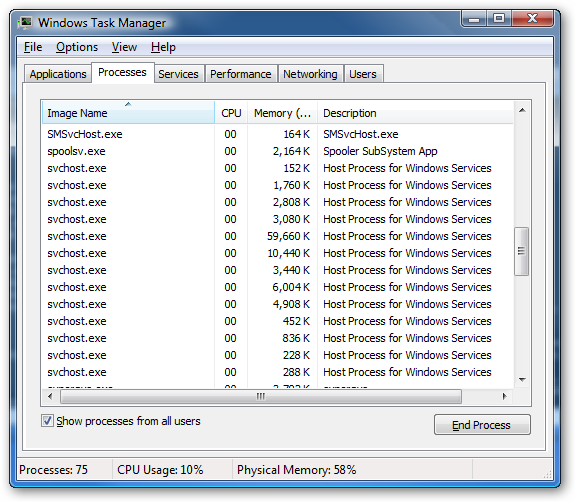
If you are curious what we're talking about, just open the Task Manager and check the "Show processes of all users" box:

Checking From the Command Line (Vista or XP)

If you want to see what services are being hosted by a particular svchost.exe instance, you can use the tasklist command from the command prompt in order to see the list of services.


tasklist /SVC


The problem with using the command line method is that you don't necessarily know what these cryptic names refer to.

Checking in Task Manager in Vista

You can right-click on a particular svchost.exe process, and then choose the "Go to Service" option.

Tips - How to disable autorun in windows

Written by IT News on 9:33 AM

Did you know that enable autorun for cdrom or USB flash disk may harm your computer.
This small of tips will guide you how to turn off the autorun in windows XP

By default when you put any cd into your cd drive, your computer will automatically load the content of the drive, it will help you to get the content faster but some virus my infact your computer during that process. I highly recommended to turn off this autorun function.

As I mention above this is a small tips but may help you, okay lets follow this step:
• First, run GPEDIT.MSC from the start-menu click run then type GPEDIT.MSC followed ENTER
• Go to Computer Configuration, Administrative Templates, System.
• Locate the entry for Turn autoplay off and modify it as you desire.

I assume that this tips will work properly in windows XP, please let me know if there something missing in this articles.

How to convert a FAT partition to NTFS

Written by IT News on 9:13 AM

I write this article based on my friend question about changing the Fat format to NTFS. For windows XP it is recommended to use NTFS partition, its faster then FAT.

In NTFS share theoretically can be of almost any size. The limit certainly exists, but not in point, since it would be more than enough for the next hundreds of years of development of information technology at any growth rates. What about practice? Much the same way. The maximum amount of NTFS share at the moment is limited only by the size of hard disks. NT4-will probably have some problems when trying to mount a drive, if any part of its steps back more than 8 GBytes of physical disk, but the beginning of this problem relates only to load share.

Okay, here is how to convert a FAT partition to NTFS, perform the following steps:

• Click Start, click Programs, and then click Command Prompt.
• In Windows XP, click Start, then click Run, type cmd (cmd is use to call the command prompt) and then click OK.
• At the command prompt, type CONVERT [driveletter]: /FS:NTFS.
• Convert.exe will attempt to convert the partition to NTFS.

Although the possibility of corruption or loss of data during the conversion from FAT to NTFS is minimal, it is best to perform a complete duplication of data on disk, it must be converted before they convert the performance of command. It is also advisable to check the integrity of the reserve before you go and run RDISK and updating the Emergency Repair Disk (ERD).

Have you move to vista?

Written by IT News on 4:18 PM

Today, if I am talking about vista it sound too late, unfortunately many user didn’t go with vista so far. Why? Is this because the lack of resources? Vista is more consume memory compare to XP.

Here is the 10 reason not to get Vista (for now)

The content is actually posted at Technology mindset, but I grab here so that you easy to read.

1. You don't actually need it -- No, think about this. Vista doesn't do anything you can't already do with XP. About the only significant shift requiring Vista is DirextX10, but as no titles support it yet and, according to John Carmack (the godfather of modern gaming) there's no need to yet either.

2. Cost $$ -- It's so blindingly obvious, most people will be blinded to it. You already have XP, and alternatives like Linux are free. If you really want to throw money away, go give it to a local charity.

3. On that note, it's outrageously overpriced -- at least in Australia. As revealed in the current APC, even after taking into account the profit margin Microsoft Australia previously applied to XP (as well as exchange rates, as you would expect), Australians are paying hundreds of dollars more for their copies than in the US. In fact, it's cheaper for Australians to buy Vista direct by mail order from the States. If you think Microsoft Australia is reaming us, vote with your wallet.

4. Upgrading hardware -- XP was demanding at release, but Vista more so. If you have an older machine that struggles with XP at the best of times, Vista is out of your ballpark unless you spend even more money to upgrade. If this is you, see point 1.

5. Driver support -- Key hardware like video and sound is crippled at the moment -- while Nvidia is working furiously to get a stable driver for the 8800 out by the 30th, there's still no SLI support for any of the Nvidia range. And thanks to the removal of hardware accelerated 3D sound in Vista, Creative's popular DirectSound based EAX no longer works at all, muting this feature for just about all gaming titles on the market today. Creative is in the process of coding a layer for its drivers to translate EAX calls to the OpenAL API which is seperate from Vista, but going by past experience with Creative drivers we won't see these any time soon.

6. Applications that don't work -- there's been plenty of coverage about applications that won't work without a vendor update. These include anti-virus, backup and security software such as those from Symantec, Sophos and ilk; CD and DVD burning tools like the suite from Nero need updated versions to work; and even basic disk management and partitioning tools such as Paragon's Hard Disk Manager are awaiting an update for Vista to be compatible. How many more will fail as Vista enters mainstream? Even Firefox has issues with Vista.

7. It's a big fat target -- with a new and untested in the global wild architecture, virus and malware authors are going to work overtime exploiting the holes Microsoft missed. In fact it's already happening. Loath though I am to use the word 'security' and 'Windows' in the same sentence, Windows XP has at least been patched to the hilt and can be used with a plethora of reasonably effective security tools that work now, without waiting for an update down the track.

8. UAC -- Oh yes, the Microsoft solution for an operating system where mutli-user was an afterthought. Sure, you can disable it, but the OS then makes it clear then that the onus is on the user for any damaging programs that got to run with permissions, rather than with Windows in the first place. If you do have it on, it is going to annoy the hell out of you. It pops up far too frequently, and even on a fast PC, the UAC screen takes too long to come up and disappear.

9. DRM -- And to a lesser degree TPM -- were made for the RIAAs and MPAAs of this world, and the even tighter integration of copy protection mechanisms and 'Windows Rights Management' into vista are nothing more than a liability to you, the user. This ComputerWorld piece says is succinctly: 'it's hard to sing the praises of technology designed to make life harder for its users.' As for TPM, this short animated video shows just how far the rabbit hole goes. And to think you pay for the privilege of having the use of media you purchased and own dictated by third parties, even on your own system.

10. The draconian license -- somehow, Microsoft has forgotten that it built its business from products that empowered its customers, not hampered them. Of course, we forget that Microsoft's customers aren't you and I, afterall (see point 9). Aside from the backward thinking that is licensing, and not actually owning, your software new terms with Vista include being able to transfer the license only once; half the limit compared to XP for Home Basic and Premium on how many machines can connect to yours for sharing, printing and accessing the Internet; limits on the number of devices that can use Vista's Media Center features; activation and validation governing your ability to upgrade hardware and use Windows itself; and outlawing the use of Home Basic and Premium with virtualisation software, and Ultimate only if DRM enabled content and applications aren't used. But then again, who reads these anyway?

For me, the main reason is I still have old application that probably didn’t work properly in Vista, those I use dual boot in my laptop.

Download Windows XP Service Pack 3 Build 5512 FINAL

Written by IT News on 8:04 AM

Microsoft combined regularly updated, fixed network, and further improvements in a single package - Service Pack

Microsoft developed updates, fixed network, and other improvements to the problems of customers and partners. To make it easier for customers to receive these updates and improvements that Microsoft regularly combined in a single package, and this package will be available for all Windows clients.

These packages are "service packs", Microsoft has with the introduction of the overview of Windows XP Service Pack 3 With the release candidate of Vista SP1 and Windows Server 2008 in the direction of laughter more tests in the last week, Microsoft and the first public cook construction of the first update of the last Windows client, the official list for Windows XP SP3 is the only crumb of this Service Pack on the mainland to the company from Redmond. The release candidate of XP SP3 in a pre-final step has already been sent MSDN and TechNet subscribers.


Install this package to get the Microsoft Multilingual User Interface Pack (MUI) Update for Windows XP Service Pack 3 (SP3). The best way to ensure you get Windows XP Service Pack 3 is by turning on the Automatic Updates feature in Windows XP.

Developer: Microsoft Corporation
License: Freeware
Size / OS: 316 MB, Windows XP
Last Updated: May 7th, 2008, 07:25 GMT
Download Windows XP Service Pack 3 Build 5512 FINAL

post tags: XP ,Service Pack, Service Pack, Update Pack ,SP3 ,OS Update, OS Fixes


How to disable autorun in windows XP?

Written by IT News on 11:13 AM

Today Tips and Tricks

This tips is inspired by my friend question, he want to disable the autorun abilities when inserting the CD or DVD disk in the CD or DVD room

Do you know why that he want to disable the auto run on windows?

Every time you insert disk to that cdrom, your computer will automatically load and read the CD contents, if it only contents a valid data if would be okey, but it would become disaster when inserted CD content a virus.

It is only a tips, but you may decide not to apply this to your computer.

Here is the step:

  • You should run GPEDIT.MSC, GPEDIT is use to edit a Grpup Policy in your local computer, Click Start, Run and type GPEDIT.MSC and press Enter;
  • Go to Computer Configuration -> Administrative Templates -> System;
  • Find the entry for Turn autoplay off and modify it as you desire.
  • Close GPEDIT and restart your computer, after reboot when you insert any disk it will not automatically start.

Using this tips is your own risk, I writing this and tested only at my computer.

Vista SP1 Confirmed for February 15

Written by IT News on 6:24 AM

Microsoft still not breathing a single word on the RTM of Vista SP1 and XP SP3
by: Marius Oiaga, Technology News Editor | softpedia.com

The Windows Vista Service Pack 1 is just around the corner. Despite the fact that Microsoft continues to point to the first quarter of 2008 as the deadline for the delivery of Vista's first service pack, it appears that the refresh will drop as early as next month. According to the Redmond company, Vista SP1 is planned for release by the end of March 2008. Microsoft has not shifted from the official timetable and failed to update it in accordance with the development of the operating system. However, it appears now that February 15 was confirmed as the RTM date for Windows Vista SP1.

Mid February 2008 is a more realistic date for the launch of Vista SP1, and one that is at the end of the natural course of evolution of the service pack's development process. Taiwanese news outlet DigiTimes, doing a story on the DRAM industry in 2008, cited Pei-lin Pai, a spokesman for DRAM manufacturer Nanya, saying: "the PC market will rebound in the second quarter. The launch of an updated version of Microsoft Vista on February 15, if its prices do not go up too much compared to its previous version, may help boost DRAM sales," (emphasis added).

Although Microsoft continues not to breathe a single word on the official RTM date of Vista SP1, it appears that the Nanya representative managed to spill the beans on the availability of the service pack. But even without confirmation from the Redmond company, the fact of the matter remains that there is an intimate connection between the release to manufacturing date of Windows Server 2008 and Vista Service Pack 1. Microsoft has virtually synchronized the development milestones for the first service pack to its latest Windows client and the testing releases of its last 32-bit server operating system.

In this context, back in December 2007, Microsoft made available for the general public, Release Candidates for both Vista SP1 and Windows Server 2008. Then, as Windows Server 2008 moved into Escrow, the final stage before RTM, the Redmond company dropped a Refresh for Windows Vista SP1 in early January 2008. At this point in time, multiple sources outside of the company have pointed to February for the RTM of Windows Server 2008.

Such a scenario also means that Vista SP1 is close to be made available in February, but with Microsoft emphasizing that, in the end, customer feedback is the deal-breaker when it comes to shipping the final version of the service pack. But, a mid February release also makes sense because Microsoft has yet to ship two prerequisite updates for Vista SP1 that will be dropped with next month's patch cycle.

In the shadow of Vista SP1 and XP Sp3, the Redmond company is also hammering away at Windows XP Service Pack 3. The last signs from Microsoft when it comes down to the third and final service pack for Windows XP were made toward the end of December 2006, with the public availability for download of the Release Candidate standalone package. XP SP3 RC was released on the heels of Vista SP1 and Windows Server 2008 and, as such, it only makes sense that the RTM version will also follow the final builds of the Windows client service pack and the server operating system.

Forget about Hacking Techniques – the New Vista SP1 RC Refresh Is Publicly Available

Written by IT News on 6:37 AM

Free for all
By: Marius Oiaga, Technology News Editor | softpedia.com

The debut of 2008 was synonymous with the availability of a new testing milestone of Windows Vista Service Pack 1, on January 9th, 2008. At that time, the Redmond company had gone private with the testing process of the first service pack for Vista. Windows Vista SP1 Release Candidate (RC) Refresh - Build 17128 is the evolution from the public RC Vista Build 6001: Service Pack 1, v.668. Initially, the Vista SP1 RC Refresh was up for grabs exclusively via Microsoft Connect, with the company offering no indication that it planned to reopen the beta testing process to all Vista users.

Following the release of the private Vista SP1 RC Refresh is 6001.17128.080101-1935 v.774, the Vista registry script dropped through Connect was leaked to the public. The redirection script is designed to modify the Vista registry in order to permit access to the latest build of Vista SP1 RC. But the hack is no longer necessary, as Microsoft has made the Vista SP1 RC Refresh available for download to the general public. Via the Windows Vista Service Pack 1 RC Refresh Public Availability Program, users of the operating system will be able to get their hands on the service pack through Windows Update.

"You must uninstall any previous versions of Windows Vista SP1 before installing Windows Vista SP1 RC Refresh. [Just] open the Programs and Features control panel and select View installed updates. In the Microsoft Windows section, right-click Service Pack for Windows (936330) and select Uninstall.
Your system will now uninstall the previous version of Windows Vista SP1 Beta and may reboot multiple times. Please wait one hour after uninstalling a previous version of Windows Vista SP1 before installing Windows Vista SP1 RC Refresh. The installer service needs to clean up and complete the uninstall prior to installing the RC. Failing to do this can result in installation errors when installing the RC version", Microsoft advised.

The Windows Update Experience for RC Refresh Public Availability.exe weighs in at 356 KB and will take your operating system through the now traditional steps associated with the deployment of the service pack. All Vista RTM users will have to deploy the KB938371 and KB937287 updates, with those running the Enterprise or Ultimate SKUs also having to install KB935509. Back in December, Microsoft also served Vista SP1 RC1 as a standalone package available through the Download Center. This is no longer valid, and if you want the latest refresh of Vista SP1 Release Candidate build 17128 you will have to go through Windows Update.

Windows Vista Service Pack 1 Release Candidate (RC) Refresh is available for download here.

Microsoft Details Windows XP SP3 Secret Changes

Written by IT News on 10:08 AM

And says it's not about security
By: Marius Oiaga, Technology News Editor | softpedia.com

If you think that all the changes that Microsoft is introducing with Windows XP Service Pack 3 are included into the official overview of the refresh, then you are sadly mistaking. The fact of the matter is that there is simply more than meets the eye, with the third and final service pack for XP, and changes run deep under the hood of the operating system.

And while the Redmond company has illustrated the evolution to SP3 by referencing the addition of such functionality, as the MMC 3.0 framework, MSXML6, Windows Installer 3.1 v2, Background Intelligent Transfer Service 2.5, IPsec Simple Policy Update for Windows Server 2003 and Windows XP, Digital Identity Management Service, Peer Name Resolution Protocol, Wi-Fi Protected Access 2, "Black Hole" Router Detection, Network Access Protection and Kernel Mode Cryptographic Module, it has also managed to leave out additional details concerning other areas of the platform.

"Windows XP Service Pack 3 (SP3) includes all previously released Windows XP updates, including security updates and hotfixes. It also includes select out-of-band releases,
and a small number of new enhancements, which do not significantly change customers’ experience with the operating system.(...) Microsoft is not adding significant functionality from newer versions of Windows, such as Windows Vista, to Windows XP through XP SP3. [However] SP3 does include Network Access Protection (NAP) to help organizations that use Windows XP to take advantage of new features in the Windows Server 2008 operating system", Microsoft revealed in the service pack's overview.

But, XP SP3 also brings to the table modifications impacting the DCE/RPC - Distributed Computing Environment/Remote Procedure Call. A detailed comparison of the modifications between DCERPC services on XP SP2 and XP SP3 (release candidate) has been published on Full Disclosure. And while the document is mostly unintelligible outside of professionals, Microsoft managed to detail the XP SP3 range check, denying that it was hiding an overflow condition.

"We have received a few inquiries about the full disclosure posting [over Windows XP SP3 - DCERPC Changes], where a range check was added in Windows XP SP3 for the Terminal Server RPC function RpcWinStationEnumerateProcesses. The speculation stated that this change was to hide an overflow condition, potentially leading to an exploitable vulnerability in previous Windows versions. In reality, this update to the Terminal Service RPC interface definition was made to better adhere to our own RPC best practices", explained a member of the Security Vulnerability Research & Defense team, subsequently citing the resource for IDL techniques interface and method design.

Find Windows vulnerabilities with a hex editor

Written by IT News on 11:03 AM

Kevin Beaver, CISSP, 09.18.2007

The hex editor is a long-time favorite investigative tool for forensics professionals. But the capabilities of the tool go

Security testing tips
Hacking Vista and planning for security breaches

Pen testing your VPN

beyond piecing together bits and bytes to prove a case. Used in the right context, a hex editor can actually uncover Microsoft Windows and application vulnerabilities that you may not have thought about, yet can't afford to overlook. In fact, the hex editor is one of the most underrated and overlooked security testing tools.

Here are just a few of the things you can do with a hex editor to root out security weaknesses in your Windows environment:

  • Check for passwords that may still be saved in Windows, Internet Explorer (IE) and other applications. Passwords left in memory can pose a risk and this technique demonstrates just how vulnerable logins and other private information can be -- especially on public computers that can be accessed by several people.
Figure 1: Using WinHex to search Firefox's memory range for sensitive information.

    If this isn't enough proof that a vulnerability exists, you can also search the computer's entire memory range for Windows application passwords or other sensitive information. Many times, I've been able to find sensitive information stored in memory by Web browsers even after the programs were closed. Searching all physical memory for this type of sensitive information is simple, fast and very revealing.

  • Search local system files, such as pagefile.sys and hiberfil.sys or the entire physical disk, for sensitive information. It's worked for me every time. This can really come in handy for spot checking computer hard drives that have supposedly been wiped before being disposed of or given away. Figure 2 shows the WinHex interface for searching local files.

Figure 2: Using WinHex to search logical drive C: for sensitive information.

  • Search for malware in memory or hidden data on disk that you wouldn't be able to see otherwise.
  • Search for "dirty" documents, such as Microsoft Word files that reveal sensitive information that should never leave the network. Those include file authors, draft verbiage, comments or third-party information that had supposedly been removed or were assumed to be non-existent since they're not visible in the native application. This comes in handy when searching for the files of those who forgot to enable the "Remove personal information from file properties on save" option.

Even with hex editors, it pays to have good tools. There are plenty of hex editors to go around. Check out the commercial alternative to WinHex called Hex Workshop or even the freebie XVI32. Don't even bother with the DOS/Windows debug tool that we used to have to rely on. Most of the hex editor features and capabilities you'll need are not there.

If you jump in head first with a hex editor, you'll be amazed at how powerful it is and what you can uncover. With this power comes some risk: A hex editor can and will modify anything on in memory or stored on disk, so be careful. The results can be beneficial or devastating. Either way, the power is in your hands.

Desktop Lock 1

Written by IT News on 1:49 PM

Enables you to apply password protection to Windows and restrict others from being able to use your PC while you are away. The Desktop Lock application was designed to be a security software that will enable users to apply password protection to Windows and restrict others from being able to use the PC.

It starts automatically with Windows and optionally locks your desktop upon loading. It hides your desktop at the same time and shows a blank screen to totally protect your privacy.

Note: Please note that the default password is = guest but you can change it at any time.

Developer: MadcroSoft
License: Freeware
Size / OS: 2.31 MB, Windows All
Last Updated: November 20th, 2007, 05:14 GMT
Download location : click here to download

The Gimp 2.4.2 Final

Written by IT News on 7:22 PM

The GIMP is the GNU Image Manipulation Program
Gimp is now more popular, this truly Free open source software are gradually improved and added with new feature. Gimp is free, but do not under estimate it features and capabilities, you can compare to other commercial software such as Adobe-cs.

The GIMP is a freely distributed piece of software for such tasks as image composition, photo retouching and image authoring. It works on many operating systems and languages.

GIMP is an acronym for GNU Image Manipulation Program. It is a freely distributed program for such tasks as photo retouching, image composition and image authoring.

It has many capabilities. It can be used as a simple paint program, an expert quality photo retouching program, an online batch processing system, a mass production image renderer, an image format converter, etc.

GIMP is designed to be augmented with plug-ins and extensions to do just about anything. The advanced scripting interface allows everything from the simplest task to the most complex image manipulation procedures to be easily scripted.

thw Gimp key features are:


Painting
· Full suite of painting tools including Brush, Pencil, Airbrush, Clone,
etc.
· Sub-pixel sampling for all paint tools for high quality anti-aliasing
· Extremely powerful gradient editor and blend tool
· Supports custom brushes and patterns

System
· Tile based memory management so image size is limited only by
available disk space
· Virtually unlimited number of images open at one time

Advanced Manipulation
· Full alpha channel support
· Layers and channels
· Multiple Undo/Redo (limited only by diskspace)
· Editable text layers
· Transformation tools including rotate, scale, shear and flip
· Selection tools including rectangle, ellipse, free, fuzzy and intelligent
· Advanced path tool doing bezier and polygonal selections.
· Transformable paths, transformable selections.
· Quickmask to paint a selection.

Extensible
· A Procedural Database for calling internal GIMP functions from
external programs as in Script-fu
· Advanced scripting capabilities (Scheme, Python, Perl)
· Plug-ins which allow for the easy addition of new file formats and new
effect filters
· Over 100 plug-ins already available

Animation
· Load and save animations in a convenient frame-as-layer format
· MNG support
· Frame Navigator (in GAP, the GIMP Animation Package)
· Onion Skin (in GAP, the GIMP Animation Package)
· Bluebox (in GAP, the GIMP Animation Package)

File Handling
· File formats supported include bmp, gif, jpeg, mng, pcx, pdf, png, ps,
psd, svg, tiff, tga, xpm, and many others
· Load, display, convert, save to many file formats
· SVG path import/export

What's New in This Release:
· Further improvement to the Print plug-in
· Completed the color management functionality for 2.4
· Store JPEG setting with the image and use them when saving as JPEG
· Further improved the rectangle tools, in particular handling of the fixed aspect ratio
· Added color profile selector widget
· Further improved the display quality for zoomed-out views

Developer: Gimp.org
License: Freeware
Last Updated: November 22nd, 2007, 08:34 GMT
Download location: click here to download

Graphic Editors

Windows Live Messenger 9.0.1407.1107

Written by IT News on 5:36 PM


The latest version of Windows Live Messenger from Microsoft
This is Windows Live Messenger version 2009 aka Windows Live Messenger 9, the latest version of Windows Live Messenger from Microsoft. WLM, right now, is in beta stage, so ONLY beta testers will be able to sign in!

Ta da! It’s the next-generation MSN Messenger. Along with everything you already love about Messenger—your contact list, emoticons, instant access to your friends—there are brilliant new ways to connect and share your photos (and other stuff). As always, Windows Live Messenger is free to download Messenger and use most of its features.

Developer: Microsoft
License: Freeware
Last Updated: November 28th, 2007, 11:26 GMT
Download location: click here to download

Disable the popup message "This Device Can Perform Faster"

Written by IT News on 10:12 PM


If you have older USB device such ver 1.1, you will got popup message "This Device Can Perform Faster" everytime pluged it into your USb potrs. Actualy this is not major problem, but you could disabled it if you want. REMEMBER! you only able to hide the error but the performance still slow unless using USB version 2.0 or higher. here is the step by step disabling the popup message above:

1. open Device manger, to do so, go to your Control panel, double-click into icon Systems;


2. click the Hardware tab, and click the Device Manager button;
3. click Universal Serial Bus controllers;
4. right-click any USb controllers in your device, then click properties;


5. click tab no 2, Advanced tab, click the check-box "don't tell me about USB errors" is located on the bottom of window


Repeat the step for all USb device or controllers you have in your device list. Note: This tips has been tested in Windows XP Pro with SP2

Create a custom Control Panel in Windows XP

Written by IT News on 9:14 PM

To simplify access to the tools in Windows XP’s Control Panel, Microsoft created the Category View, in which the Control Panel’s tools are organized into categories. If you’re an old-school Windows user, you can still switch back to the Classic View, in which all of the Control Panel’s tools are available. If you admire the simplicity of the Category View but prefer the Classic View, you may want to create your own custom Control Panel that combines the best of both views. Here’s how:

  1. Right-click the Start button and select the Explore command.
  2. Go to File | New | Folder.
  3. Name the new folder My Control Panel.
  4. Right-click your new My Control Panel folder, select the Properties command, choose the Customize tab, click the Change Icon button, and select an icon that will differentiate this folder from all the rest on the Start menu.
  5. Open your new My Control Panel folder, and then open the original Control Panel and select Classic View.
  6. Drag and drop your favorite tools from the original Control Panel to your new My Control Panel folder.
  7. Close both your new My Control Panel folder and the original Control Panel.
Now when you need to use your favorite tool, just click Start | All Programs and at the top of the All Programs menu select the My Control Panel folder. You’ll see your favorite tools in an easy to access drop-down menu.

Use firewall for your security

Written by IT News on 9:23 PM

If you always connected to the internet to help you find something or for your work, or for just browsing, it's highly recommend to always activate your firewall, especialy if you running windows XP and don't third-party firewall software.

And if you don't know what is firewall,
firewall is a hardware or software device which is configured to permit, deny or proxy data through a computer network which has different levels of trust, in other case i can say that firewall is your god for security. And windows xp SP2 already built in standard firewall.

Windows Firewall, previously known as Internet Connection Firewall or ICF, is a protective boundary that monitors and restricts information that travels between your computer and a network or the Internet. This provides a line of defense against someone who might try to access your computer from outside the Windows Firewall without your permission.

If you're running Windows XP Service Pack 2 (SP2), Windows Firewall is turned on by default. However, some computer manufacturers and network administrators might turn it off. But please do not turm it off for any reasons.

To open Windows Firewall

  1. Click Start and then click Control Panel.
  2. In the control panel, click Windows Security Center.
  3. Click Windows Firewall.

Security Center


Read more regarding windows firewall at http://www.microsoft.com/windowsxp/using/security/internet/sp2_wfintro.mspx
or findout more what is firewall at http://www.webopedia.com/TERM/f/firewall.html

Tips: Shortcut to System properties

Written by IT News on 9:06 PM

Many ways to get into System properties such as goto control panel and double click System icon or by right clicking on my computer folder within explorer.

Here I saw you the shortest way to get the system properties:

  • from your keyaboard, press windows button + pause break button at the same time
Note: assume that your keyboard has a windows logo button or known windows start button


if this tips work for you, please vote or give some comment

Search This Blog

Ads and Sponsored by:


Want to subscribe?

Subscribe in a reader.